devlin wrote:...you make mention of the 5 valve head. Others here have commented that it's less efficient than a 4 valve head. What are your comments on this?
Empirical testing might give an answer; but for the time being armchair reasoning will have to do! What is the rationale of the five-valve head? Well, typically, in both two-valve or four-valve heads, the inlet valves are bigger than the exhaust valves, for the obvious reason that exhaust gases exit easily under pressure, whereas, unless the induction is pressurized (by a supercharger, turbocharger, or even simple ram-air), the fresh fuel/air mix is drawn in by a partial vacuum.
An engineer chooses four valves rather than two for dual advantages: (i) better volumetric efficiency; and (ii) higher revs are possible (and therefore more power is available) if the reciprocating valves weigh less. BUT, since the inlet valves are bigger than the exhaust valves, it is the higher mass inlet valves that limit maximum revs...
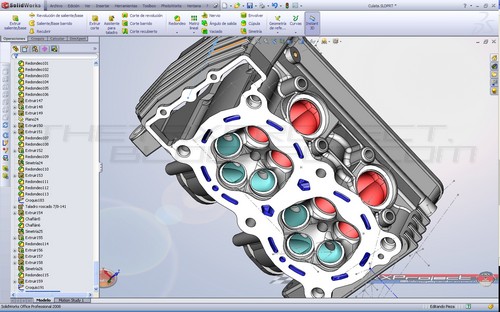
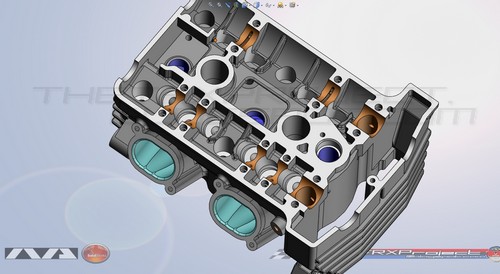
Enter the 5-valve head. With three inlet valves and two exhaust, not only should volumetric efficiency be good; but also, since all five valves have similar (small) size and mass, the maximum rev limit (and maximum power) should be greater. Small valves are not only shorter than bigger valves, they have a shorter travel, and the cams are smaller; and all this means that the valve gear can be more compact. The argument for a five-valve head seem impeccable; and even if it is marginally more costly than a 4-valve head, this expense is a small proportion of the cost of the whole bike.
The 5-valve single engine in the Yamaha XT660 and the MZ Skorpion shows that the concept works well and reliably. Just one thing: if really high revs are not the ultimate aim, and if mid-range power is the target, then why not settle for a 3-valve head? A 3-valver has a ratio of inlet valve area to exhaust valve area of 2:1, which is better than the 5-valver's ratio of 3:2. Ducati, having introduced first the ST2, and then the ST4, finally abandoned both for the ST3 that provided a sensible compromise of performance, reliability, and cheapness. It follows that the TRX could probably have done almost as well as a 3-valver!
In another context, I used to have a Citroen Xantia 1.9 with 2 valves per cylinder; and I upgraded to a 2.1 Xantia with 3 valves per cylinder (both turbodiesels). The 2.1 litre engine has 15% more power and 25% more torque than the 1.9. QED?
Finally, I read in a recent Motor Cycle News that a firm claims to have perfected the rotary valve design, resulting in better volumetric efficiency, better fuel/air mixing, an escape from the reciprocation of poppet valves, and a VERY compact cylinder head. BMW, who have just announced a 4-valve dohc version of its boxer twin (!) might have done better to use such rotary valves and reduce the engine width by eight inches or so!.




 Very impressive and well done for the top 10, now for the number 1 slot.