modelling 850cc engine - model ready

Please share your secrets! What mods have you made to your TRX?

Moderators: trixynut, Mincehead, dicky, phuk72, Jak, Kevtrx849

Post Reply
Artsi_L

modelling 850cc engine - model ready

Post by Artsi_L » Fri Jan 09, 2009 11:15 am

I am modelling TDM/TRX859cc engine on a computer program. I would welcome if anyone would happen to have either stock head air flow data, or ported head flow data. Such data can be tracked on a flow bench. It is costly, and that is the reason I don't have the data on my cylinder heads.
Any 5-valve head motorcycle flow data is also welcome. That will give me a starting point.

The main objective of this PC modelling is to nail in on perfect camsaft timing for my intended goal (it'll end up in a XTZ frame, so engine will be doing off-roading and gravel-roading).
Trying out few different timings on an engine dyno will take a whole day. That's expensive.

Here's a link to the software I am using for modelling: http://www.performancetrends.com/Engine ... o_v3.3.htm

Before anyone says PC based dynamometers can not work, I can say that numerous people have gotten torque and power curves within few percent of actual engine dynamometer figures.
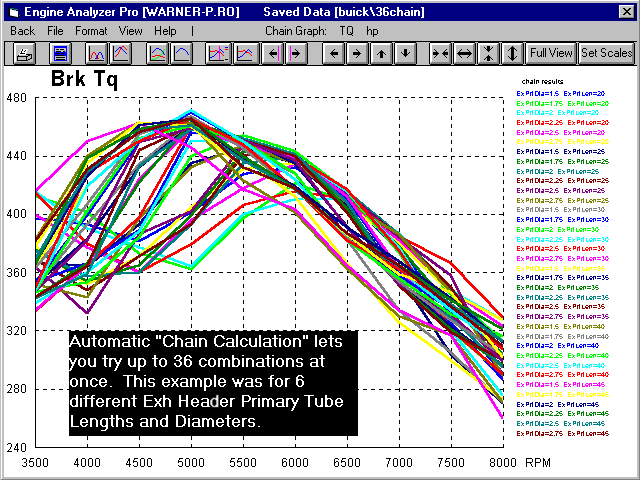
The main idea of such modelling is to see trending, rather than predict exact power curves. It is very useful to make good/perfect selection on engine tuning components before buying the tuning components, rather than going to the dynamometer with engine that has wrong compression ratio, wrong size carburation, wrong size exhaust primaries, wrong camshaft, etc...


Cheers; A


Image


Image


.
Last edited by Artsi_L on Tue Apr 07, 2009 1:34 pm, edited 2 times in total.

User avatar
Quan-Time
Site Sponsor
Posts: 943
Joined: Tue Jan 16, 2007 7:17 am
Location: Riding or swingin a spanner

Re: modelling 850cc engine - specs needed

Post by Quan-Time » Tue Jan 13, 2009 3:08 pm

computer engine dynos do work.. I agree with you.. But as you say, a few % out. Usually because you cant plot for fuel temps, and ram air, etc.. you can get damn close tho.

I have a flow bench, i have a TRX head.. No i dont have the numbers on hand, but yes i have them somewhere. Dont expect them anytime soon. Im inherently lazy :(


remember kids, 1.98cfm = 1hp (in golden conditions, you can get surprisingly close on a street head with correct tune)
Do you use velo / pressure numbers aswell ? or only raw CFM ?
-------------------
I dont have a sig
-------------------

Artsi_L

Re: modelling 850cc engine - specs needed

Post by Artsi_L » Wed Jan 14, 2009 6:42 pm

Quan-Time wrote: Do you use velo / pressure numbers aswell ? or only raw CFM ?

---

Here's a pic of the head flow input window. It allows operator to use either coefficient factor, or flow table. Vacuum unit can be altered to be XX inches water pressure.

The sample data window here is from software's data archive, it's a Yamaha FJ1200. Some Mitch Stevens (whoever he is) has allowed software developers to distribute his entire model of a FJ1200 engine.

My TRX/TDM850 engine model is in it's infancy. It is running with guestimated values (i.e. fixed coeff. factors on inlet & exhaust head flow, exhaust system CFM, camshaft duration and timing, plus many others..). I have 750cc base engine (XTZ750) horse power curve resembling therebouts a dynoed hp curve I've found in the net.

Is there much difference in TRX/TDM camshafts?
Duration/timing data on either?

For cam I've used 235º duration at 0,050" lift, both lobe centers at 110º.

Is my check-up-dyno-data between XTZ-TDM-TRX close to real world data?


cheers, A


.

User avatar
dandywarhol
Site Sponsor
Posts: 1639
Joined: Fri Nov 24, 2006 12:56 pm
Location: Edinburgh, Scotland

Re: modelling 850cc engine - specs needed

Post by dandywarhol » Sat Mar 07, 2009 10:17 am

TDM/TRX cams are identical Artsi
1996 TRX 850, blue, Ohlins 46HRCLS, Race Tech Gold Valves, 0.90 springs, Venom pipes, R6 brakes............
1974 Yamaha RD250A, Candy Blue
1998 Yamaha SZR660, blue of course
1967 Yamaha TD1C 250, Blue and white

Artsi_L

Re: modelling 850cc engine - specs needed

Post by Artsi_L » Tue Mar 31, 2009 7:06 am

I've been tinkering with simulation model of a 859cc TDM/TRX engine.
Cylinder head flow data is estimated based on good old rules of thumb, and cross referenced to various motorcycle/snowmobile head flow data posted on numerous internet sources. Every attempt has been made to have realistic flow numbers fed into the simulation model. It's a shame that I've been unable to obtain actual Yamaha head flow data. That would have greatly helped to get real life results out of the software modelled engine.

All major components around the engine have been modified to support mid powerband torque characteristics (i.e. inlet/exhaust pipe diameters and lenghts, camshaft duration and timing, CR ratio).
I got an eye opener epiphany while browsing through BMW 800GS engine specification sheet. I changed over a few parameters, and hey presto, that made my virtual engine more to my liking.

My design goal is to have strong torque at relatively moderate rpm, it's a cross country & trail traveller bike afterall (XTZ750). I am not chasing high horsepower figures, which by the way can be had close to 130hp with appropriate software modelling changes.
A small possible mistake in modelled head flow data, and perfect inlet/exhaust manifold tuning will net that close to 130hp, while real world highly tuned Yamaha 878cc TRX seems to top out at about 120hp. That real world TRX may have less than perfect inlet runner lenght, exhaust primary lenght/diameter, camshaft timing... etc. Maybe that real world engine could push that extra 5-8 hp when everything is sorted out - or maybe I indeed have a small mistake on software modelled head flow data numbers.

I set out to seek trending of different engine components. The simulated torque graph may well be slightly off in max torque numbers, however I do wish to rely on the torque curve shape vs. rpm.
It's known that software will give realistic results when input data is correct. In this case, some of the important data is guestimated, hence the results have to be taken with a grain of salt.

Here below is my virtual engine torque graph. I guess the max figures are somewhat resembling real world torque curves, but at lower rpm.
The virtual graph has lb/ft numbers on left, and Nm on right.


cheers, Arto

Post Reply